Addressing Health Misinformation with Young People
Scroll through any teen's social media feed for five minutes and you'll likely encounter at least one piece of health advice: a "miracle" supplement, a detox tea, a workout that promises instant results, or someone confidently diagnosing a mental health condition based on a list of symptoms. Some of it might be accurate. A lot of it isn't. And most teens don't have the tools to tell the difference.
Health misinformation is everywhere online, and teens are particularly vulnerable to it. As caring adults, we can't just tell young people to "stop believing everything you see online" and expect that to work. Instead, we need to understand why this content is so appealing in the first place and equip teens with practical tools to evaluate what they're seeing.
What Is (Health) Misinformation?
Misinformation is inaccurate or false information. Health misinformation is any health-related claim of fact that is false based on current scientific consensus. Disinformation is also false information, but it's misleading on purpose.
Unfortunately, social media is full of both health misinformation and disinformation. This can include misleading claims, poorly labeled ads, unchecked health advice, heavily filtered or edited images, self-diagnosis and misinformation loops, and promotion of potentially harmful behaviors.
Truly, anyone can say anything on social media, even if they don't have the expertise or facts to back it up. There's no gatekeeper, no fact-checker, no requirement to show your credentials before you hit "post."
Adolescents are especially vulnerable to health misinformation for a variety of reasons. First, they're often trying to fit in with what their peers are thinking and doing (e.g. “if other people my age are using this product or doing this type of ‘wellness’ behavior, then maybe I should too”). Teens are also frequently wondering, "Is this normal?" As funding for health education continues to be cut, fewer and fewer young people are getting accurate health information from adults they trust. And on top of all that, teens can be particularly swayed by the strategies influencers use regularly: relatability, social connection, and emotional appeals.
The Appeal of Digital Health Information
When you stop to think about why teens might be especially drawn to digital health information, it actually makes a lot of sense. There are four key reasons this content appeals so strongly to adolescents.
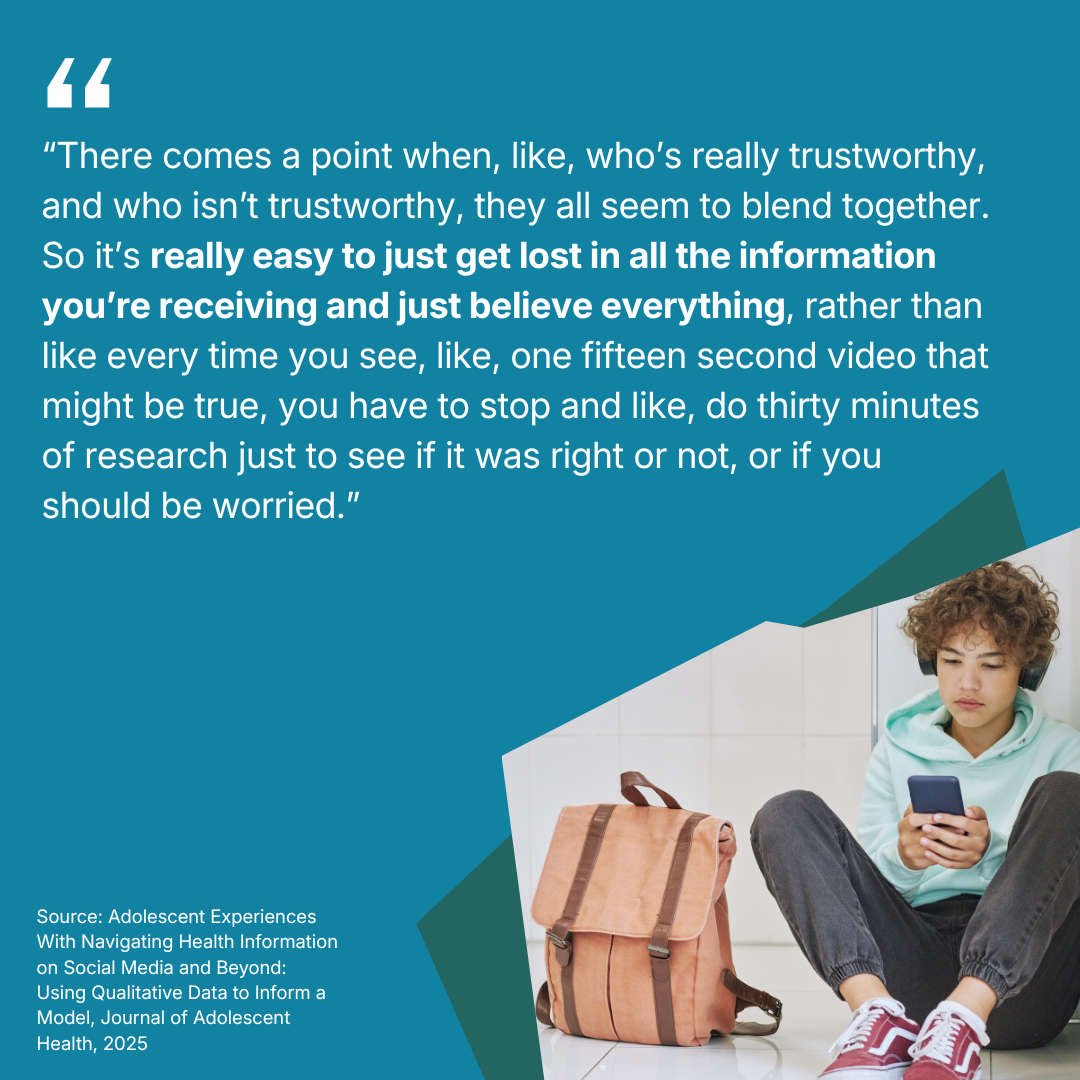
Ease of access. Information can be accessed anywhere, at any time. It's succinct, easy to understand, engaging, and visually appealing. It’s essentially everything a scrolling teen is primed to respond to.
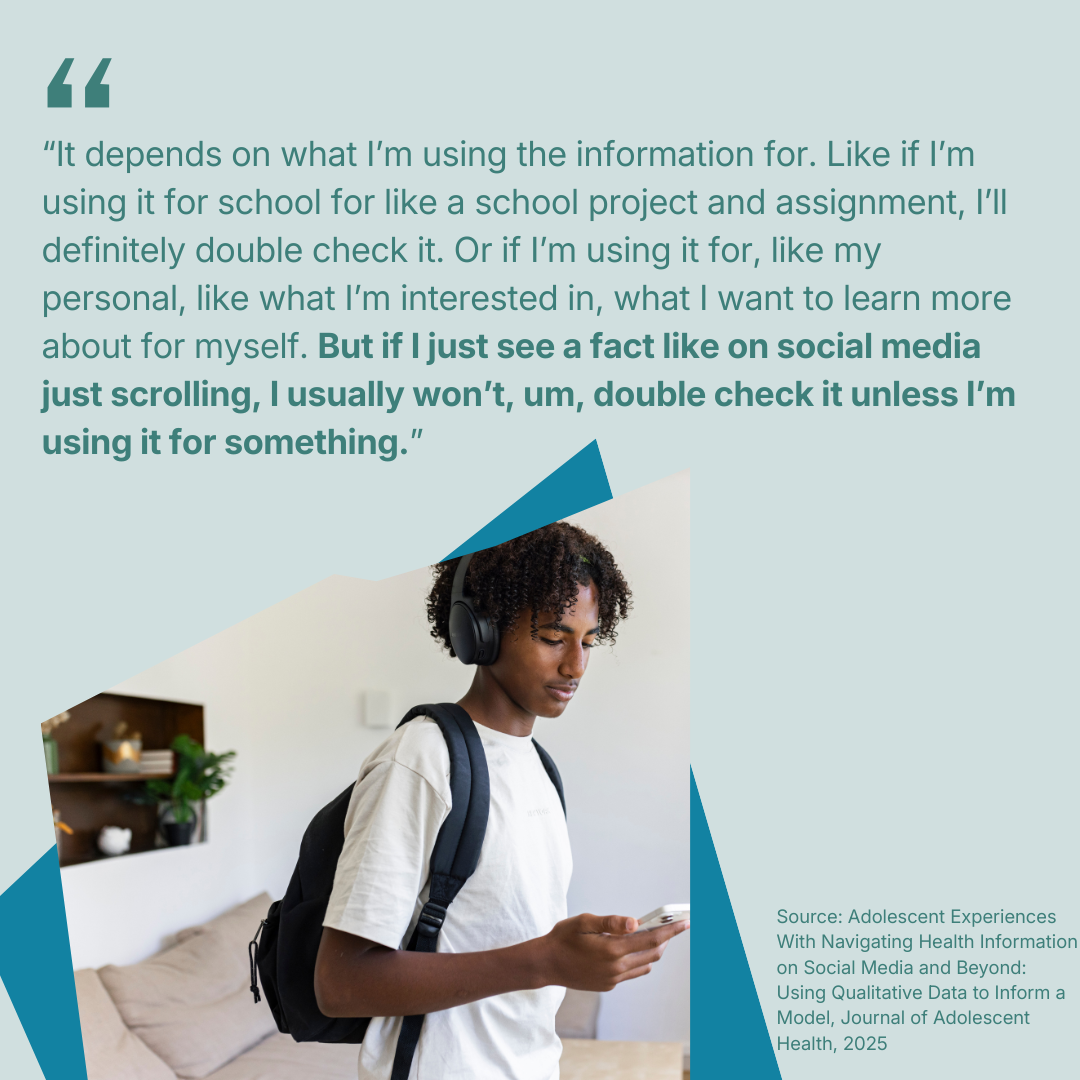
Personal and societal factors. Misinformation is more likely to be believed in difficult situations or when someone is really unfamiliar with a topic. For most young people, talking to a health professional is reserved for only very necessary or severe situations. Young people may also be restricted from accessing other forms of information. For example, a parent or caregiver might opt them out of sex ed lessons or insist that sexual health information is only appropriate after marriage. When adults limit access to information, teens don't stop being curious, they just go find answers somewhere else.
Anonymity. Mobile devices feel private and often more comfortable than asking a caregiver, trusted adult, or health professional. Teens cite the privacy of accessing health information online as a core benefit, especially for content they consider sensitive or embarrassing.
Volume of information. There is just so much information out there. Everyone can find something that appeals to them or reinforces what they already believe, and the algorithm supports that misinformation loop, feeding teens more of whatever they've already shown interest in.
The good news is that adolescents still see doctors as the most credible source of health information for diagnosis and treatment, and they prefer trusted adults for acute health questions. This tells us that trust in professionals and caring adults hasn't disappeared, it's just being supplemented, and sometimes complicated, by what teens find online.
That said, teens also:
Prefer online resources for topics they consider sensitive
Use online sources to supplement what they learn from parents, providers, and schools
Confirm or question information they heard from a provider online
Seek out online sources when they didn't have access to mental health care
Turn to online sources when they don't have a friend to talk to about mental health concerns
So the goal isn't to compete with the internet or pretend it doesn't exist in a teen's health journey. It's to help them navigate it more critically.
Addressing Health Misinformation with Teens
So what do we actually do with all of this? Here are five approaches that can help:
Start with a foundation of trust.
Make social media a regular part of the conversation and build trust by asking what apps they're using, why they like them, how they like to use them, and who they follow.
It's also worth checking in on amount of use (how it affects sleep, other activities, and time with friends, and how they set their own limits) and asking directly about what kind of health content they're seeing.
Avoid demonizing social media.
If the first thing out of your mouth is "social media is dangerous," you'll likely lose a teen's willingness to engage with you on the topic at all. Instead, try to take more of a tech neutral or tech positive approach.
Tech neutral sees social media as a tool whose impact depends on how it's used, and focuses on teaching discernment. Tech positive acknowledges the challenges but emphasizes digital spaces as places for real growth, connection, and creativity. Most teens respond best when we lead from somewhere between neutral and positive, curious rather than fearful.
Practice a strengths-based approach.
It can be really frustrating when teens come to you with information that is so cleary misleading or harmful. However, know that you know why teens are so much more vulnerable to health misinformation, you can dig into your empathy on this. Try to withhold judgement and instead, get curious about where they found the information.
Practice active listening by giving them space to explain what they've heard and why it interests them. Acknowledge that not all information on social media is bad or harmful, and consider what you might learn from it together. Then offer accurate, evidence-based information, thinking about what sources will actually appeal to them.
Cultivate responsible social media use.
I find that one of the most helpful ways to support teens in using social media responsibly is to help them better understand the ins and outs of how social media actually works. It’s a kind of Social Media 101. For example:
People get paid to promote products, experiences, etc.
How can you tell when someone is being paid to promote something?
The algorithm will feed you more of what you interact with.
How can you ensure that you get more content that is accurate and healthy for your health/mental health and less that harms your health/mental health?
The more you pay, the more your content is seen.
How can you tell when someone has paid for their content to be more visible?
Anyone can say almost anything on social media.
How can you tell when someone is actually an expert in what they’re talking about?
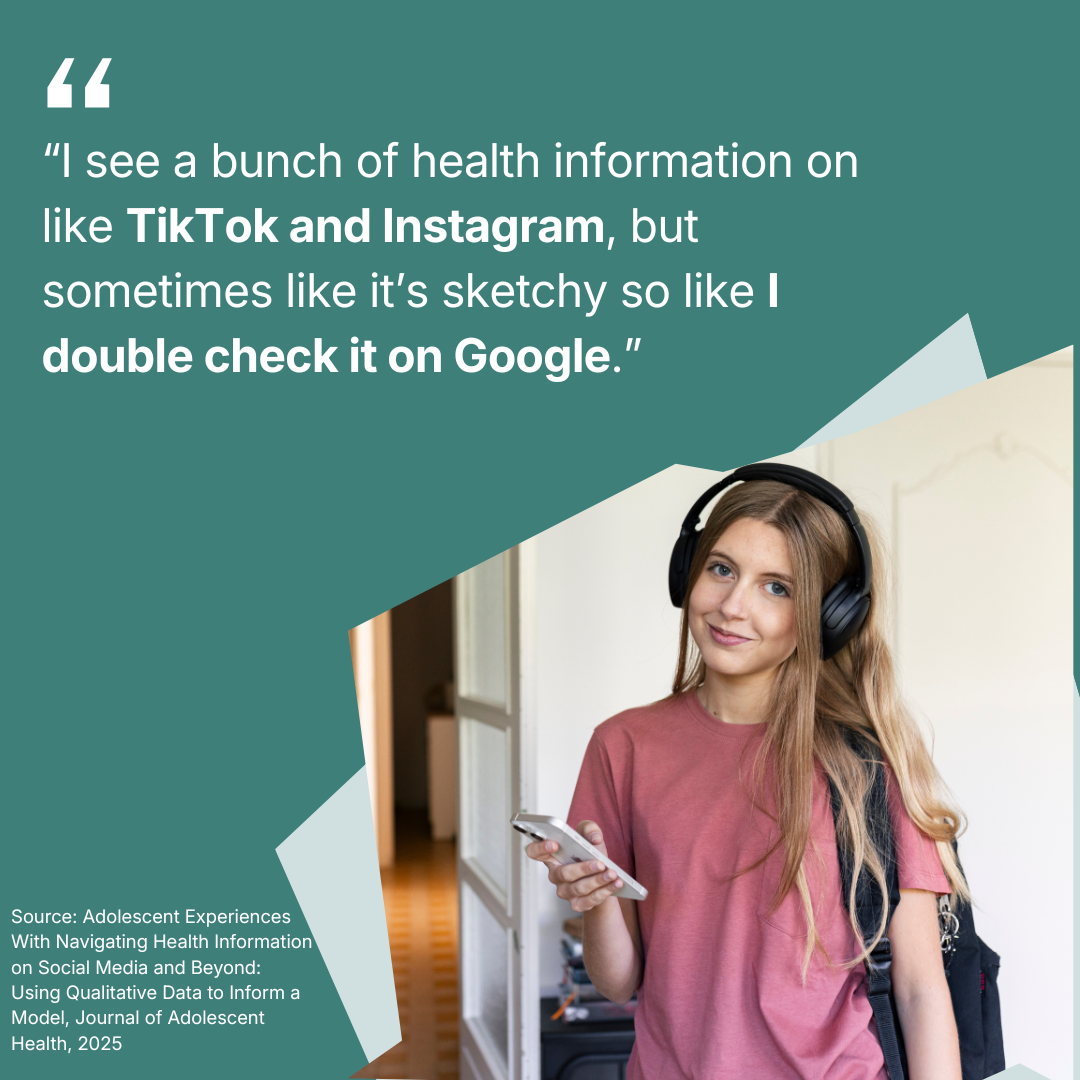
Once young people better understand how social media adapts to influence them, they can be better at critically thinking about what kinds of message they are consuming.
Promote digital health literacy.
Finally, this is the skill-building piece. It’s critical to give teens concrete tools they can use every time they encounter health content online.
Just like in middle school English class, where we were taught to ask who, what, when, where, why, and how about a piece of writing, I propose a similar framework for promoting digital health literacy: the 4 Ws and 1 H.

5 Questions to Ask About Social Media
The next time you or a teen in your life comes across a health claim online, encourage them to think about these five questions.
1. Who created this content?
All media has a creator and an agenda. The creator usually has a particular vision, background, and point of view they're trying to communicate. Ask:
Are they an expert in this area? What is their background?
What is their motivation for creating this content?
Who was not involved in creating this?
Is this a fact, an opinion, or something else?
How credible is this, and how do you know?
How do I know I can trust this creator to give me credible information about this topic?
2. What ways is the content trying to get my attention?
Content creators use specific tactics to hook viewers, and once you know what to look for, they become much easier to spot. Ask whether the creator is using any of the following:
Emotional appeals
Exaggerated facts
Claims of unique or secret information
Celebrity or influencer status
Humor
Flashy or cute videos, images, or branding
Relatability
Social media trends
Fake authority
3. Why was this content created?
Understanding the purpose behind a piece of content can tell you a lot about how much to trust it. Ask:
Was it made to inform, educate, entertain, sell, or persuade?
Is the goal to gain power, profit, or influence?
Who's the intended audience?
What does it want me to do?
Who paid for this, and who profits from it?
Hint: Most often, the answer is to make money.
4. Which identities, values, lifestyles, and points of view are represented or missing?
Content doesn't exist in a vacuum, and what's left out can be just as telling as what's included. Ask:
How does that impact the content being shared?
How might this perpetuate stereotypes or miss crucial information?
What does this content want me to think, or think about?
What could someone learn from this?
What meanings, values, and perspectives are obvious, and what are implied?
What is left out that might be important to know?
5. How does this content make me feel?
This last question might be the most important one, because our emotional reactions often drive our behavior before our critical thinking catches up. Ask:
What emotions is this content trying to make me feel?
How do my emotions influence my interpretation of this content?
Is my emotional reaction influencing me to act in a way that's not in line with my values or best judgment?
Is this content making me feel badly about myself, or causing me to compare myself to unrealistic people, lifestyles, or expectations?
Building Critical Thinkers, Not Just Cautious Ones
Teens are going to encounter health misinformation online whether we like it or not. We can't fully prevent that, and honestly, trying to control every piece of content they see isn't a realistic strategy. Instead, we can equip them with the tools to slow down, ask good questions, and think critically about what they're consuming.
That's a skill that will serve them well beyond their teen years, in every corner of their digital life.
The next time a teen in your life mentions something they saw online, try resisting the urge to immediately correct or dismiss it. Get curious instead. Ask them who made it, why they think it was made, and how it made them feel. You might be surprised at how much critical thinking they're already capable of, especially once someone shows them how.
Looking for more resources on healthy social media use? I offer interactive workshops for parents and youth-serving professionals including one on Addressing Health Misinformation with Teens. I also have an on demand course for parents on who want to start connecting with their teen about social media.