Four Simple Strategies for Setting the Stage with Groups of Teens
Whether you're brand new to working with adolescents or you've been doing it for years, there are moments when facilitating a group of teens feels magical and moments when it feels like a nightmare. Sometimes the energy is flowing, the group is vibing, and you're thinking, "this is why I do this work." Other times? Crickets. Blank stares. Or the complete opposite - total chaos where nothing goes the way you planned.
I've been working with teens for more than 15 years, and I still have sessions that fall into both categories. But over time, I've developed some strategies that help set the stage for success, create a sense of safety, and make it much more likely that things will go well.
Read on or click below to watch to learn four simple but powerful strategies that can work in any setting, whether you're teaching a class, running a workshop, leading a therapy group, or facilitating any kind of activity with young people.
What's Actually Happening During Adolescence

Before we dive into the strategies, it's worth taking a step back and remembering something important - there is SO much happening during this time of life. This is helpful to remember whether you're new to working with teens or you've been doing it forever. Adolescence is wonderful and exciting, but it's also really tricky, not just for caring adults, but for teens themselves.
Think of all the things that are happening from ages 12 to 24:
Physical growth and development
Increased risk taking
Identify and values formation
Intense emotions
Self-consciousness and self-awareness
Changing schools
Increased responsibilities
More academic pressure
First jobs
More independence
Romantic relationships and dating
Leaving home for the first time
I could go on and on, and there are plenty of things that aren’t on this list. It's helpful when we're struggling with a group of teens to ground ourselves again in all of the big things happening during this phase of their lives.
It might also be helpful to reflect on your own experience: What was I worried about when I was a teen? What were some of my biggest challenges or concerns at this age?
That reflection can help us build empathy for those moments when working with teens is challenging.
Strategy 1: Set Group Agreements

Setting group agreements is a simple strategy, but it can give you a lot of traction with a group. The key is tailoring your approach to how much time you have with this particular group.
If you have one or two hours: Keep it quick and easy - two minutes or less. Give them two or three preset agreements. Something like: respect me, respect each other, and participate as much as you can. Simple and straightforward.
If you have multiple sessions: Give more time to developing group agreements. Ideally, the agreements will come from the group themselves. You can give them specific prompts or give them an acronym to fill out (ROPES is a classic and usually gets you all the things you’re looking for). I love using an old-fashioned piece of flip chart paper and some big markers for this - we write out what we agree to as a group, it's mostly generated by the group itself, and I post it somewhere in the space where we're meeting.
Having those agreements visible (or at least stated clearly) gives you something to come back to if things start to get off track. I can point to the sign or say, "Hey, remember y'all agreed to these three things at the beginning."
One more way to get buy-in: have them show you they agree. If you just have a short amount of time, you can ask for a thumbs up. If you’re going to be together for multiple sessions or a whole semester, you can ask them to grab a marker and sign their name to the group agreements poster so they're actively showing they'll try to stick to what you've agreed on.
But what if they don't agree? I get this question a lot. Here's the thing: I've worked with so many groups of teens over 15 years, and I honestly can't remember a time when I didn't have a student agree. I've definitely had eye rolls. I've had teens slowly walk up to the flip chart and reluctantly sign their name. But I've never had anyone outright refuse.
If someone did refuse, my approach would depend on the context. In a quick, one-time session, I might just move on and say something like, "I really hope you can get on board with these as we go. Let's keep moving." If it's a group I'll be with for a long time, I might ask them one-on-one: "What on this list are you having a hard time agreeing to?" Just to make sure there's not something I'm missing.
Bottom line: group agreements should be a non-negotiable. They need to be there in some way, shape, or form, tailored to how long you have with the group.
Strategy 2: Show Them You're Happy They're There

This seems simple, but it’s so key for this age group to feel welcome.
Teens are constantly stereotyped as difficult, challenging, frustrating, or hard to deal with. And teens know that. They feel it. So one of the best things you can do to create safety is to authentically and consistently show them you are happy to be with them.
For some of us, that might mean checking our own biases about working with teens. It might mean taking a deep breath and getting back on track if we had a difficult group previously. It might mean looking internally and asking ourselves: What was triggering me last time? What was pushing my buttons?
We need to do that work so we can show up in the best way for this group.
Teens often feel that they're unwelcome and that people assume the worst about them. Let's work against that. Show them through your nonverbals, facial expressions, body language, and tone of voice that you're glad to be there. Greet them. Smile. Ask them questions. Get to know them.
All of those little things matter, regardless of what the purpose of the group is. Whether you're teaching math, running group therapy, or giving a museum tour, the best way to set the stage is to make sure they know you're glad to be with them in that moment.
The other key part of this is that it needs to be genuine. You can't fake it. Teens are the best BS detectors out there. So truly tap into that empathy, especially on the tough days.
Strategy 3: Encourage Participation

Encouraging participation might sound obvious, but how we do it makes all the difference.
Thank people when they respond. Use nonverbals like nodding, eye contact, facial expressions. Reflecting back what you heard them say is also really powerful. This is a common therapist strategy, but any supportive adult can use it. You might say, "What I heard you say was..." and then paraphrase their response.
This checks that you got the meaning right. If you did, they will feel heard and understood. If you're wrong, that's okay too. They can correct you and tell you what they meant instead. I've heard a lot of young people say they really appreciate and value this approach.
Beware of one person doing all the talking. Sometimes group dynamics develop where one person always responds, and that can really shut down the rest of the group. It's great that they're sharing, but you don't want them to be the only one. Do some gentle redirecting. You might say, "Let's get someone other than Bobby to answer this question," or "Jane, I know you have a thought on this, but let's give some space for other folks to respond."
Being really direct about it builds trust with the group. They know you've got this, you're not going to let one person monopolize the conversation, and you care about what everybody has to say.
Offer a variety of ways to engage. Not all young people feel comfortable participating in the same way. They don't all process the same way and they don't all have the same ability to verbally express their opinions or thoughts.
If you can, incorporate different types of learning: large group discussions, small group discussions where peers talk to each other, individual reflection or writing, activities that have people standing up and physically moving around the space if you have room and time for it. That variety benefits everyone.
One strategy I really like is think/pair/share. This allows young people to first think about the prompt you've given them, then pair up in twos or threes to talk about it with each other, and finally share out to the larger group. It hits multiple engagement strategies all in one.
Strategy 4: Be Mindful About Language
Young people today, more than ever, are exploring their identities. One way we can lose an individual or an entire group is to gender them without knowing how they identify.
If you know how students identify (maybe you have name tags with pronouns, folded name cards on desks, or pronouns in their Zoom names) great, use that information. But if you don't know how they identify, be really thoughtful about the wording you use.
Avoid gendered terms like Miss, Mr., Sir, or Ma'am. I'll admit I used these pretty often earlier in my career because I wanted to show young people I respected them, and that felt like a way to do it. But I didn't always know how they identified. Now, I would not use those terms unless I knew for sure.
Embrace the singular "they." We use this all the time in everyday conversation when we don't know someone's pronouns. We might say, "Oh, they left their backpack in the cafeteria." Default to that until you know for sure.
Avoid phrases like "boys and girls" or "ladies and gentlemen." I hear this so often. It's not ill-intended, but it can have a negative impact. If I'm a student who is non-binary or genderqueer, I don't fit into "boy" or "girl," "lady" or "gentleman." You've already lost me when you start to use that phrase.
Opt for alternatives that make sense for you and how you talk: everyone, folks, students, y'all, learners, etc. There are so many fun and creative options. Use what makes sense for your setting and your personality.
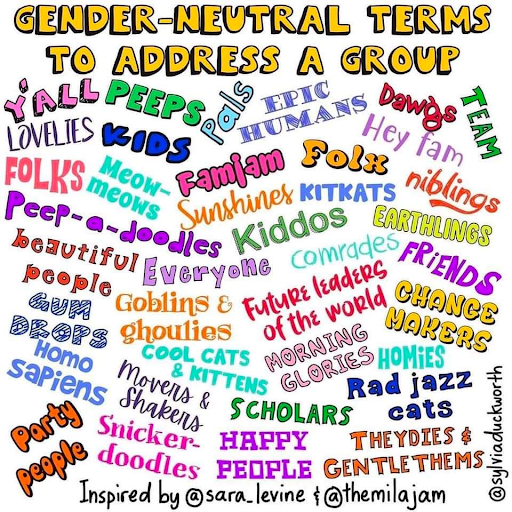
This can make a big difference and create a sense of safety for students who identify outside the binary. And students who do identify within the binary as boys or girls likely won't even notice what you're doing. It's the students who already feel dismissed or excluded who are really going to notice and appreciate it.
Setting the Stage for Success
Here’s the recap:
Set group agreements
Show they you’re happy they’re there
Encourage varied participation
Be mindful about language
These four strategies can transform how groups of teens respond to you. They create safety, build trust, and set the stage for the kind of engagement and connection that makes working with young people so rewarding.
Remember: adolescence is a time of incredible growth, intense emotions, and big transitions. When we approach teens with empathy, clear boundaries, and genuine care, we're not just facilitating better group dynamics, we're showing up as the supportive adults they need during this complex time of life.
Stay tuned for part two, where I'll share strategies to increase engagement when you have a group that's a little too quiet or isn't giving you a lot to work with.
Want more resources for working with teens? I offer interactive workshops for youth-serving professionals on topics like healthy technology use, effective communication with teens, and creating inclusive spaces for LGBTQ+ youth. Learn more at k-cornelison.com or subscribe to my biweekly newsletter, both/and, at bothandnewsletter.com.